

Signs of Arthritis in Dogs: How to Help Your Aging Pet
Dogs slow down as they get older. That’s just what happens, and most owners chalk it up to age. But stiffness, walking less, or struggling to get around isn’t always a normal part of getting old. Sometimes it’s a joint problem underneath it all. Arthritis, or osteoarthritis, is one of the most common culprits in senior dogs, and knowing the signs of arthritis in dogs early can make a real difference in how your pet feels day to day.
Vets describe osteoarthritis as a joint disease that worsens over time, bringing inflammation, cartilage damage, and pain along with it. It usually shows up in older dogs, though younger ones aren’t immune either. Injuries, genetics, bad joint development- any of these can trigger it early. The American College of Veterinary Surgeons explains canine osteoarthritis and its causes in detail.
What Is Arthritis in Dogs?
Picture the cartilage inside a joint as a cushion. Arthritis wears that cushion down bit by bit until bone starts rubbing against bone. Pain follows. So does swelling and stiffness.
Common joints affected by arthritis include the hips, knees, elbows, spine, and shoulders.
There’s no real cure once it sets in. Catch it early, though, and manage it well, and a dog can still live an active, comfortable life.
Signs of Arthritis in Dogs
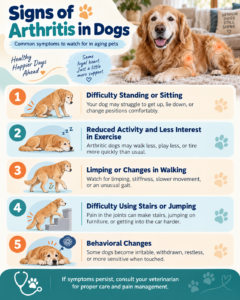
1. Difficulty Standing or Sitting
Watch how your dog gets up after lying down. Struggling to stand, hesitating on the stairs, moving stiffly right after a nap- these are classic signs of arthritis in dogs. Movement tends to loosen things up a little, but the stiffness creeps back after long stretches of rest.
2. Reduced Activity and Less Interest in Exercise
A dog in pain often quietly steps back from things it used to love. Maybe it’s:
- Walking less
- Playing for shorter bursts
- Skipping runs or jumps
- Sleeping more than usual
People write this off as normal aging all the time. It’s not always that simple. Sometimes it’s the joints talking.
3. Limping or Changes in Walking
An uneven gait is a big tell. Limping, shifting weight from leg to leg, walking slower than usual, all worth noticing. Some dogs get worse right after exercise. Others stiffen up once they’ve been resting a while.
4. Difficulty Using Stairs or Jumping
Anything that leans on joint strength can turn painful fast. Watch for hesitation before:
- Climbing stairs
- Hopping onto the couch
- Getting into the car
If a dog that used to do these things without thinking suddenly won’t, something’s probably hurting.
5. Behavioral Changes
Pain messes with mood too. A dog may become more aggressive, avoid humans or react defensively to being handled near the painful area. Even a normally easygoing dog can react sharply if you press on the wrong joint.
How to Help a Dog With Arthritis
Maintain a Healthy Weight
Extra pounds mean extra pressure on already struggling joints. Keeping your dog at a healthy weight, through good food and sensible portions, eases that load and helps them move more easily.
Provide Gentle Exercise
Total rest actually backfires here. Stiffness gets worse, not better. Short walks and easy swimming keep muscles working without hammering the joints too hard.
Ensure a Safe Environment
The little things stack up quickly:
- Acquire a bed that is orthopedic to get genuine support.
- Put down non-slip flooring
- Provide ramps for jumping areas
- Keep food and water within easy reach
FAQs
What is the first sign of arthritis in dogs?
Typically, it’s stiffness immediately after resting, hesitation on stairs or decreased interest in play or activity.
Can arthritis in dogs be cured?
Not really, no. However, symptoms can be significantly improved and quality of life maintained with the proper treatment, weight management and exercise program.
When do dogs start to develop arthritis?
Middle age onward is common. Still, younger dogs can develop it too, usually tied to injury, genetics, or joint issues from early on.
References
- American College of Veterinary Surgeons. Osteoarthritis in Dogs.
https://www.acvs.org/small-animal/osteoarthritis/ - Innes, J. F. (2012). Canine Osteoarthritis: Current State of Knowledge and Treatment Options. Veterinary Medicine: Research and Reports.
https://www.dovepress.com/canine-osteoarthritis-current-treatment-options-peer-reviewed-fulltext-article-VMRR - Johnston, S. A. (1997). Osteoarthritis: Joint Anatomy, Physiology, and Pathobiology. Veterinary Clinics of North America: Small Animal Practice.
https://doi.org/10.1016/S0195-5616(97)50051-0





1 comment
Furrbe Design
https://www.youtube.com/@furrbe